Eternal Inflation, Boltzmann Brains, and the Difficulty of Trusting One’s Own Conclusions
cosmology
foundations
philosophy of physics
On a cosmological measure problem, on the proposition that one is more likely a fluctuation than a person, and on what one is to do about an argument that would undermine its own premises.
Author
Affiliation
D. R. Caldera
Chuck Walla Institute
Published
29 December 2007
A small problem, of the sort one mulls over in winter
It is not, as a rule, the Institute’s habit to write on the cosmological literature. The matter is large, the measurements are sparse, and the arguments tend to flower in directions for which the desert provides no particular advantage. The present note is an exception, occasioned by a long evening, a settled stove, and the slow accumulation of papers on a question which has been called — variously, and not always charitably — the problem of Boltzmann brains.
The proposition, in its simplest form, is this. If the universe is eternally inflating in the sense of Linde (1986), so that new Hubble volumes are continually generated and the global spacetime persists without end, then the great majority of observers in the resulting ensemble are not the products of cosmological structure formation, of stars and chemistry and a long evolutionary history, but are instead thermal fluctuations — brief, accidental, nearly-but-not-quite randomly assembled patterns of matter, of just sufficient organization to constitute, for an instant, an observer. The argument was made forcefully by Dyson et al. (2002) and has been worried over since.
If the proposition is true, the reader is, with overwhelming probability, one of these fluctuations.
Why one might believe such a thing
The reasoning, set out plainly, has three parts.
First, an eternal de Sitter spacetime — which our universe appears asymptotically to be approaching — has a finite temperature \(T_{\text{dS}} = H/2\pi\) and a finite entropy \(S_{\text{dS}} = \pi/(H^{2}
\ell_{P}^{2})\). For our values of \(H_{0}\) this entropy is approximately \(10^{122}\) in units of Boltzmann’s constant. That is large, but it is not infinite. The system has a finite phase space. It will, given enough time, recur(Dyson et al. 2002).
Second, in any finite-entropy thermal system, fluctuations of any specified configuration occur with a probability suppressed roughly by
\[
P \;\sim\; \exp\!\left[-\Delta S / k_{B}\right],
\tag{1}\]
where \(\Delta S\) is the entropy reduction required to assemble the configuration. For a fluctuation to a configuration as orderly as a human brain — say \(\Delta S \sim 10^{42}\) — the suppression is severe; but the time available is, in eternal de Sitter, longer still. The expected wait time for a single such fluctuation is on the order of \(\exp(10^{42})\) Hubble times.
Third, the great cosmological epochs in which ordered observers like ourselves can be produced — periods of structure formation, the long afternoon of stelliferous chemistry — are by comparison brief. The universe’s record of having produced complex observers by the honest route is a few tens of billions of years. The record of producing observers by fluctuation is, on the standard accounting, very nearly forever.
The ratio is unflattering.
A picture of the timescales
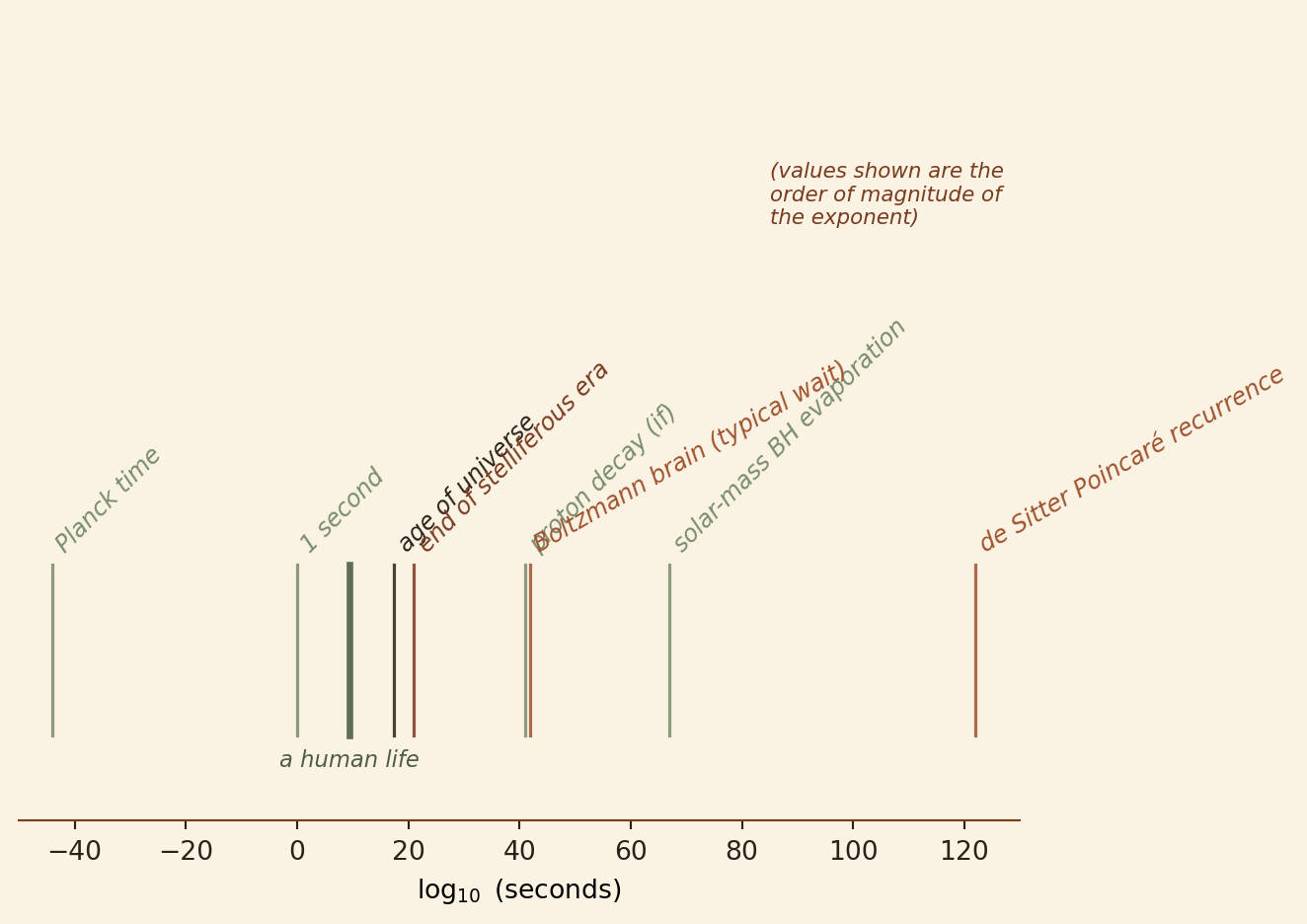
The plot below sets the relevant durations on a logarithmic axis. The human-scale events occupy a thin strip near the left margin; the fluctuation timescales occupy the unmarked remainder of the page.
import numpy as npimport matplotlib.pyplot as plt# Each entry: (label, log10(seconds), color)events = [ ("Planck time", -44, "#7a8b6f"), ("1 second", 0, "#7a8b6f"), ("age of universe", 17.5, "#2b2118"), ("end of stelliferous era", 21, "#7a3b1f"), ("proton decay (if)", 41, "#7a8b6f"), ("solar-mass BH evaporation", 67, "#7a8b6f"), ("Boltzmann brain (typical wait)", 42, "#a0522d"), ("de Sitter Poincaré recurrence", 122, "#a0522d"),]fig, ax = plt.subplots()# Background gradient suggesting the scale of empty axisax.axvspan(-50, 130, color="#faf3e3", zorder=0)for label, x, color in events: ax.plot([x, x], [0, 1], color=color, lw=1.2, alpha=0.85) rotation =45 yoff =1.05if"Boltzmann"in label or"Poincaré"in label: rotation =30 ax.text(x, yoff, label, rotation=rotation, fontsize=9, ha="left", va="bottom", color=color, fontstyle="italic")# A reference: where a human life sitsax.plot([9.4, 9.4], [0, 1], color="#4f5e48", lw=2.5, alpha=0.9)ax.text(9.4, -0.18, "a human life", fontsize=8.5, color="#4f5e48", ha="center", fontstyle="italic")ax.set_xlim(-50, 130)ax.set_ylim(-0.5, 4.2)ax.set_yticks([])ax.set_xlabel(r"$\log_{10}$(seconds)")ax.spines["left"].set_visible(False)ax.spines["right"].set_visible(False)ax.spines["top"].set_visible(False)ax.spines["bottom"].set_color("#7a3b1f")ax.tick_params(axis="x", colors="#2b2118")ax.set_facecolor("#faf3e3")fig.patch.set_facecolor("#faf3e3")# Note: the BB and Poincaré markers are placed at log10(log10) of the# actual exponent — i.e., at the order of magnitude of the exponent,# not at the literal value, which would be unrepresentable on any# physically achievable plot.ax.annotate("(values shown are the\norder of magnitude of\nthe exponent)", xy=(85, 3.0), fontsize=8, color="#7a3b1f", fontstyle="italic", ha="left")plt.tight_layout()plt.show()
Figure 1: A logarithmic accounting of cosmological durations, in seconds. The age of the universe and the lifetime of the longest-lived stars are visible only because the axis has been compressed; the Boltzmann-brain and de Sitter recurrence timescales are placed at their order of magnitude in the exponent. The plot is, in a precise sense, mostly empty.
The plot is, as the caption notes, somewhat dishonest: the Boltzmann-brain and Poincaré-recurrence ticks are placed at the order of magnitude of the exponent of the actual timescale, because the timescale itself is not representable on any axis we could draw. If we drew the recurrence time honestly, the universe’s age would not appear at all.
The objection that interests me
The numerical case is striking, and there are several ways one might respond to it. One could argue that the measure on the eternally inflating ensemble is the wrong measure (Bousso and Freivogel (2007)); one could argue that the de Sitter phase is not eternal because some other instability intervenes (Dyson et al. (2002)); one could argue that the calculation of \(\Delta S\) for an observer is wrong by many orders of magnitude (Page (2008)). All of these are plausible. The Institute holds no view.
What interests me, sitting here, is a different kind of objection, which has been pressed in various forms by Albrecht and Sorbo (2004) and Hartle and Srednicki (2007), and which I shall paraphrase. If the cosmological model implies that I am very probably a Boltzmann brain, then the evidence I have for the cosmological model — my memories of graduate school, of Caltech, of the texts on the shelf behind me — is itself very probably the product of a momentary fluctuation, and is therefore evidence of nothing in particular. The argument has eaten its own premise. A cosmology in which I am most likely a Boltzmann brain is a cosmology in which I have no good reason to believe the cosmology.
This is what is meant, in the literature, by cognitive instability. A theory that predicts the unreliability of its own evidence cannot be coherently held.
The objection is, I think, decisive — though not in the way it is sometimes presented. It does not refute the cosmology in the sense of showing it false. It refutes the cosmology in the older and gentler sense of showing it unreasonable to assert. We are entitled to believe theories on the basis of the evidence available to us; we are entitled to act on that belief; and a theory that, accepted, denies us that entitlement has, in the moment of acceptance, declined to be a theory we can live by. One does not need to refute it. One sets it aside and goes on.
What one does, then
There remains the practical question of what to do with the proposition that one’s evidence may not be evidence. The reader, like the author, has presumably resolved this question by waking up in the morning and continuing to behave as though his recollections were trustworthy. This is the right resolution. The cosmology, if it is a problem, is a problem for cosmology; it is not a problem one carries out to feed the dogs.
I find the matter sits more easily out here than it did when I was younger and lived nearer to a city. The stones at the edge of the property have been in approximately their present configuration for several million years. The wind has scoured them; the seep below the windmill has watered them; a particular juniper, of disreputable shape, has grown beside one of them within recorded memory. None of these things are fluctuations in any reasonable sense. They are facts about the world, slow and durable, and they will not be rescinded by a measure-theoretic argument concocted in a warm room.
The dogs, at the moment, are on the porch. The stove is doing its work. I have set down my glass to finish this paragraph, and I shall pick it up again. If I am wrong about all of this, I shall not, in the relevant sense, ever know.
References
Albrecht, Andreas, and Lorenzo Sorbo. 2004. “Can the Universe Afford Inflation?”Phys. Rev. D 70: 063528.
Bousso, Raphael, and Ben Freivogel. 2007. “A Paradox in the Global Description of the Multiverse.”JHEP 2007 (06): 018.
Dyson, L., M. Kleban, and L. Susskind. 2002. “Disturbing Implications of a Cosmological Constant.”JHEP 2002 (10): 011.
Hartle, James B., and Mark Srednicki. 2007. “Are We Typical?”Phys. Rev. D 75: 123523.
Linde, Andrei D. 1986. “Eternally Existing Self-Reproducing Chaotic Inflationary Universe.”Phys. Lett. B 175: 395–400.
Page, Don N. 2008. “Is Our Universe Likely to Decay Within 20 Billion Years?”Phys. Rev. D 78: 063535.