The result we wish to recover
The electron’s gyromagnetic ratio receives its first radiative correction at order \(\alpha\) . Schwinger’s celebrated result is
\[
a_e \;\equiv\; \frac{g-2}{2} \;=\; \frac{\alpha}{2\pi} + \mathcal{O}(\alpha^{2}).
\tag{1}\]
Numerically \(\alpha/2\pi \approx 1.1614 \times 10^{-3}\) , accounting for the bulk of the measured anomaly.
The vertex function
Define the on-shell vertex by
\[
\bar u(p')\,\Gamma^{\mu}(p',p)\,u(p)
\;=\; \bar u(p')\!\left[
F_1(q^{2})\gamma^{\mu} + \frac{i\sigma^{\mu\nu}q_\nu}{2m}\,F_2(q^{2})
\right]\!u(p),
\]
with \(q = p' - p\) . The form factor \(F_2(0)\) is the anomalous moment. At one loop \(F_2(0)\) is infrared-finite even though \(F_1(q^2)\) is not — the IR divergences sit entirely in the charge renormalization piece.
The Feynman parameter integral
After the standard manipulations one arrives at
\[
F_2(0) \;=\; \frac{\alpha}{2\pi}\int_{0}^{1}\!\!dx\int_{0}^{1-x}\!\!dy\;
\frac{2 m^{2} z(1-z)}{m^{2}(1-z)^{2}} \;=\; \frac{\alpha}{2\pi}\int_{0}^{1}\!\!dz\,(1-z) \cdot \frac{2z}{(1-z)},
\]
with \(z = x + y\) , which collapses to
\[
F_2(0) \;=\; \frac{\alpha}{2\pi} \int_{0}^{1}\!\!dz\;2z \cdot \tfrac{1}{2}
\;=\; \frac{\alpha}{2\pi}.
\]
This recovers Equation 1 .
A numerical sanity check
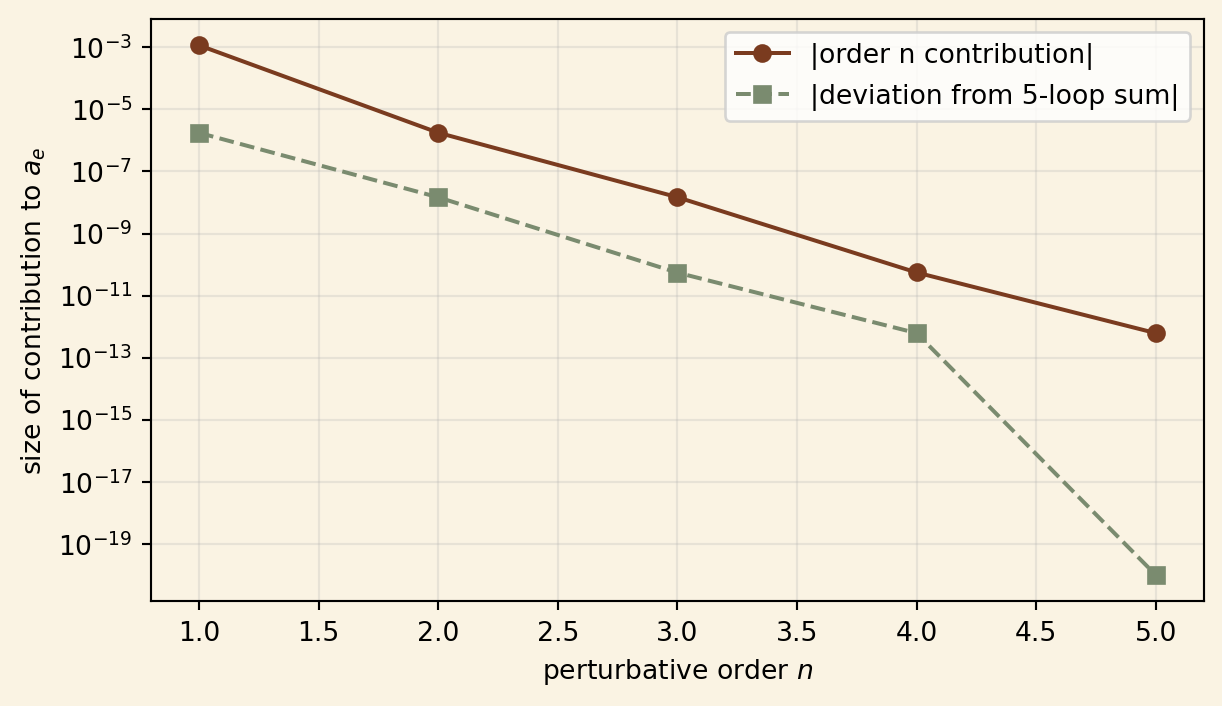
import numpy as np, matplotlib.pyplot as plt= 1 / 137.035999 # Coefficients C_n in a_e = sum_n C_n (alpha/pi)^n (electron, QED only, schematic) = [0.5 , - 0.328478965 , 1.181241 , - 1.9106 , 9.16 ]= [C[n] * (alpha/ np.pi)** (n+ 1 ) for n in range (len (C))]= np.cumsum(contribs)= plt.subplots(figsize= (6.5 , 3.8 ))= np.arange(1 , len (C)+ 1 )abs (contribs), 'o-' , color= "#7a3b1f" , label= "|order n contribution|" )abs (cum - cum[- 1 ]) + 1e-20 , 's--' , color= "#7a8b6f" , label= "|deviation from 5-loop sum|" )"perturbative order $n$" )r"size of contribution to $ a_e $ " )"#faf3e3" )"#faf3e3" )= 0.25 )print (f"a_e (one-loop) = { contribs[0 ]:.6e} " )print (f"a_e (five-loop) = { cum[- 1 ]:.10e} " )
Figure 1: Successive theoretical contributions to \(a_e\) (cumulative). Each tick is one further order in \(\alpha\) .
a_e (one-loop)  = 1.161410e-03
a_e (five-loop) = 1.1596521777e-03
Why this still matters
The electron \(a_e\) is the most precisely known prediction in physics. The agreement between five-loop QED and experiment is at the part-per-trillion level, and any disagreement in the next decimal place is news. The desert, unfortunately, contributes nothing to the running budget; we read about the new measurements like everyone else.