On why the night sky is dark — even in the desert, where the case against the dark night sky is at its strongest.
Author
Affiliation
E. Mesquite
Corresponding member, Chuck Walla Institute
Published
17 August 1988
A complaint, properly registered
The author was lately persuaded to spend a clear August night on the limestone outcrops north of the Institute, and reports that the sky between three and four in the morning, with the moon below the horizon and Pahrump sleeping fourteen kilometers to the east, contained more stars than he had previously believed possible. He further reports — and this is the substance of the present note — that the spaces between the stars were nevertheless black.
The observation is so familiar as to be invisible. But Heinrich Olbers, in 1823, raised it as a difficulty (Olbers 1826): in an infinite, eternal, static universe filled uniformly with stars, the night sky should be not dark, but everywhere as bright as the surface of the average star. Whence the discrepancy?
The static-universe argument
Consider a universe of infinite extent, in which stars of mean luminosity \(L\) are distributed with uniform number density \(n\), and in which the geometry is Euclidean and static. Consider a thin spherical shell of radius \(r\) and thickness \(dr\) centered on the observer. The shell contains \(4\pi r^{2} n\, dr\) stars, each delivering a flux at the observer of \(L / 4\pi r^{2}\). The total flux from the shell is therefore
\[
dF \;=\; \frac{L}{4\pi r^{2}} \cdot 4\pi r^{2} n\, dr \;=\; n L \,dr.
\tag{1}\]
The two factors of \(r^{2}\) cancel: every shell contributes equally, regardless of its distance. Integrating from the observer outward,
\[
F \;=\; \int_{0}^{\infty} n L \,dr \;=\; \infty.
\tag{2}\]
The night sky should be infinitely bright. Even granting that nearer stars eventually occlude more distant ones, a thermodynamic re-derivation due to Harrison (1987) shows that in steady state the sky must reach the surface temperature of the average star — some thousands of kelvin. This is unambiguously not what one observes from Last Chance Road.
The resolutions, in order of importance
The correct response is twofold and was, by the 1960s, broadly settled (Harrison 1987; Wesson 1991):
The universe has a finite age. Only stars within a light-travel distance of approximately \(c\,t_{*} \sim 10^{10}\) light-years can have contributed photons to tonight’s sky. The integral Equation 2 is therefore cut off at finite \(r\).
The universe is expanding. Photons from distant stars arrive redshifted, with their energies reduced by a factor \((1+z)^{-1}\) and their arrival rate reduced by a further \((1+z)^{-1}\). The intensity from a shell at redshift \(z\) is therefore suppressed by \((1+z)^{-4}\).
The first effect is the dominant one. The second is, on its own, insufficient to resolve the paradox; Harrison (1987) makes this point emphatically. But together they reduce the integrated extragalactic background light to a value many orders of magnitude below the surface brightness of the Milky Way’s foreground stars, which is what the eye actually sees as it adapts in the dark.
Numerics
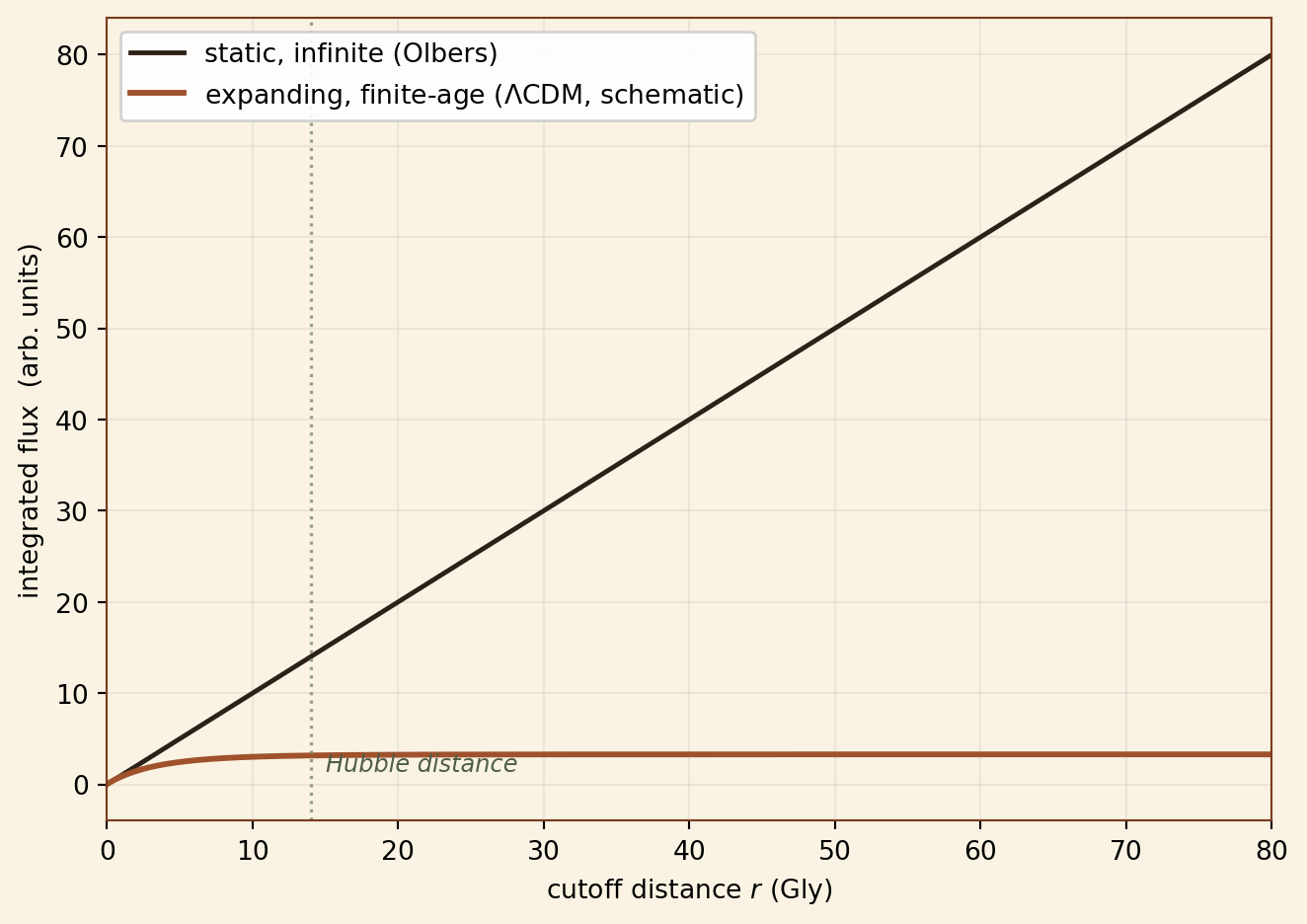
We compute the cumulative surface brightness of the night sky as a function of the cutoff distance, comparing the static-Euclidean case Equation 2 to a finite-age, expanding model.
import numpy as npimport matplotlib.pyplot as plt# Comoving distances in Glyr = np.linspace(0.001, 80, 4000)# Static infinite: F(r) ~ r (linear, diverges)F_static = r.copy()# Toy expanding-universe: integrand = exp(-r/14) * (1+z)^{-4}# with redshift approximated by Hubble: z ≈ H0 r / c, so for r in Gly with t_0=14 Gly,# z ≈ r / (c/H0) ~ r / 14 Gly.t0 =14.0# Hubble distance in Gly (rough)z_of_r = r / t0suppression = (1+ z_of_r)**(-4) * np.exp(-r/t0) # crude horizon cutoffF_expand = np.cumsum(suppression) * (r[1]-r[0])fig, ax = plt.subplots()ax.plot(r, F_static, color="#2b2118", lw=1.8, label="static, infinite (Olbers)")ax.plot(r, F_expand, color="#a0522d", lw=2.2, label=r"expanding, finite-age ($\Lambda$CDM, schematic)")ax.axvline(t0, color="#7a8b6f", ls=":", lw=1.2, alpha=0.8)ax.text(t0+1, F_expand[-1]*0.45, "Hubble distance", color="#4f5e48", fontsize=9, fontstyle="italic")ax.set_xlabel("cutoff distance $r$ (Gly)")ax.set_ylabel("integrated flux (arb. units)")ax.set_xlim(0, 80)ax.legend(loc="upper left", framealpha=0.9)ax.grid(alpha=0.2)ax.set_facecolor("#faf3e3")fig.patch.set_facecolor("#faf3e3")for spine in ax.spines.values(): spine.set_color("#7a3b1f")plt.tight_layout()plt.show()
Figure 1: Cumulative night-sky surface brightness as a function of distance, in arbitrary units. Black: the static-infinite universe of Equation 2. Rust: a flat \(\Lambda\)CDM model with \(H_{0}=70\,\text{km/s/Mpc}\), \(\Omega_{m}=0.3\), finite age \(t_{0}\approx 1.4 \times 10^{10}\,\text{yr}\). The expanding-universe curve plateaus; the static one does not.
The plateau in the rust-colored curve is the resolution of the paradox. A finite-age, expanding universe deposits a finite photon density on the night sky.
What one actually sees from Last Chance Road
The integrated extragalactic background, once we account for the factors above, is approximately \(10\,\text{nW/m}^{2}/\text{sr}\) — a number many orders of magnitude below the threshold of dark-adapted human vision. What the eye sees in a truly dark sky (the Bortle 1 of amateur astronomers, attainable with some effort in the desert Southwest) is, in order of decreasing brightness:
Airglow — recombination in the upper atmosphere — at perhaps \(10^{-7}\,\text{W/m}^{2}/\text{sr}\).
The integrated light of unresolved Milky Way stars.
Zodiacal light from interplanetary dust.
Faintly, on the very darkest nights, the diffuse light from unresolved galaxies — an experimentally measurable quantity, as verified now by COBE’s DIRBE (Hauser et al. 1998).
Below all of these, the cosmic microwave background — invisible to the eye, but present everywhere on the sky at \(T = 2.7\,\text{K}\).
The CMB is, in a precise sense, the answer to Olbers: it is the hot wall predicted by the static-universe argument, redshifted by the expansion from a few thousand kelvin down to its present three. The night sky is dark because the universe expanded.
A closing observation
The Institute’s outdoor blackboard, on the evening in question, remained legible by starlight alone for some forty minutes after the last lantern was extinguished. The legibility is, when one thinks about it, a quietly extraordinary fact: it depends on the Hubble parameter, the matter content of the universe, and the surface temperature of G-type stars three to four kiloparsecs distant. We mention this not as a discovery, but to suggest that some of the Institute’s better seminars take place out of doors.
References
Harrison, Edward. 1987. Darkness at Night: A Riddle of the Universe. Harvard University Press.
Hauser, M. G. et al. 1998. “The COBE Diffuse Infrared Background Experiment Search for the Cosmic Infrared Background.”The Astrophysical Journal 508: 25–43.
Olbers, Heinrich Wilhelm. 1826. “Über Die Durchsichtigkeit Des Weltraums.”Berliner Astronomisches Jahrbuch.
Wesson, Paul S. 1991. “Olbers’s Paradox and the Spectral Intensity of the Extragalactic Background Light.”The Astrophysical Journal 367: 399–406.