On the Apparent Passage of Time at Six Mile Spring
relativity
philosophy of physics
block universe
A note, occasioned by a long evening, on the relativity of simultaneity, the Putnam–Rietdijk argument, and the block universe.
Author
Affiliation
D. R. Caldera
Chuck Walla Institute
Published
21 September 1983
A small puzzle, restated
It is by now an old observation, but one that bears repeating in the cool of an autumn evening, that the special theory of relativity does not contain a quantity we might fairly identify with the passage of time. Spacetime contains events. Events stand in invariant geometrical relations to one another. The sensation that some of these events are now, while others have receded into the past or wait in the future, finds no representation in the equations.
This essay records, for the use of the Institute’s library and any visiting scholar who may have arrived during a thunderstorm and now finds himself detained, the standard derivation of the conclusion most often associated with Putnam (1967) and Rietdijk (1966): that two observers in relative motion necessarily disagree about which distant events are simultaneous with their own present, and that, on a natural reading, this disagreement leaves no room for an objective, world-wide now.
The relativity of simultaneity, briefly
Consider two observers, \(O\) and \(O'\), in inertial motion relative to one another with velocity \(v\) along the \(x\)-axis. The Lorentz transformation relates their coordinates by
Two events at the same time \(t\) in \(O\)’s frame, separated by spatial distance \(\Delta x\), are not simultaneous in \(O'\)’s frame; rather, they are offset by
The relation Equation 2 is the entire content of what we shall need.
A numerical illustration, from the porch
Let \(O\) be an observer seated, motionless, on the porch of the Institute at Six Mile Spring. Let \(O'\) be the driver of an eastbound pickup truck on Last Chance Road, who has just turned onto Nevada State Route 160 and is headed toward Las Vegas at the legal limit of fifty-five miles per hour, or \(v \approx 24.6\,\text{m/s}\). The distance from the Spring to the Las Vegas Strip, by way of Pahrump and the Spring Mountains, is approximately \(\Delta x = 110\,\text{km}\).
The simultaneity offset Equation 2 evaluates, with the relevant numbers, to
or thirty picoseconds. The driver’s now, as it slices through the Strip, is offset by thirty picoseconds from the now of the porch. This is, by any reasonable standard, an unimpressive quantity. The point is not the magnitude.
The point is that the offset is non-zero, and that it depends on the driver’s velocity and on the direction in which she happens to be looking. Were she to make a U-turn, her plane of simultaneity would tilt the other way; were she to accelerate to a higher speed, it would tilt further. There is, in the geometry, no preferred slicing of spacetime into simultaneous events; there are only the slicings that particular observers happen to adopt.
The Andromeda generalization
The argument is sometimes felt to acquire its force only when extended to larger distances. Following the original presentation: replace Las Vegas with the Andromeda galaxy, at a proper distance of \(\Delta x \approx 2.5
\times 10^{6}\) light-years, and replace the pickup truck with a leisurely walk in the direction of Andromeda at \(v \approx 1\,\text{m/s}\). Then
which is three days. If one elects to walk toward Andromeda, the events on Andromeda which one regards as “happening now” are offset by three days relative to the events one regarded as “happening now” while standing still. A decision to take a step has, on this reading, an immediate consequence for what is real in a galaxy two and a half million light-years away. We do not propose to defend this construal; we simply observe that the geometry does not refuse it.
The picture
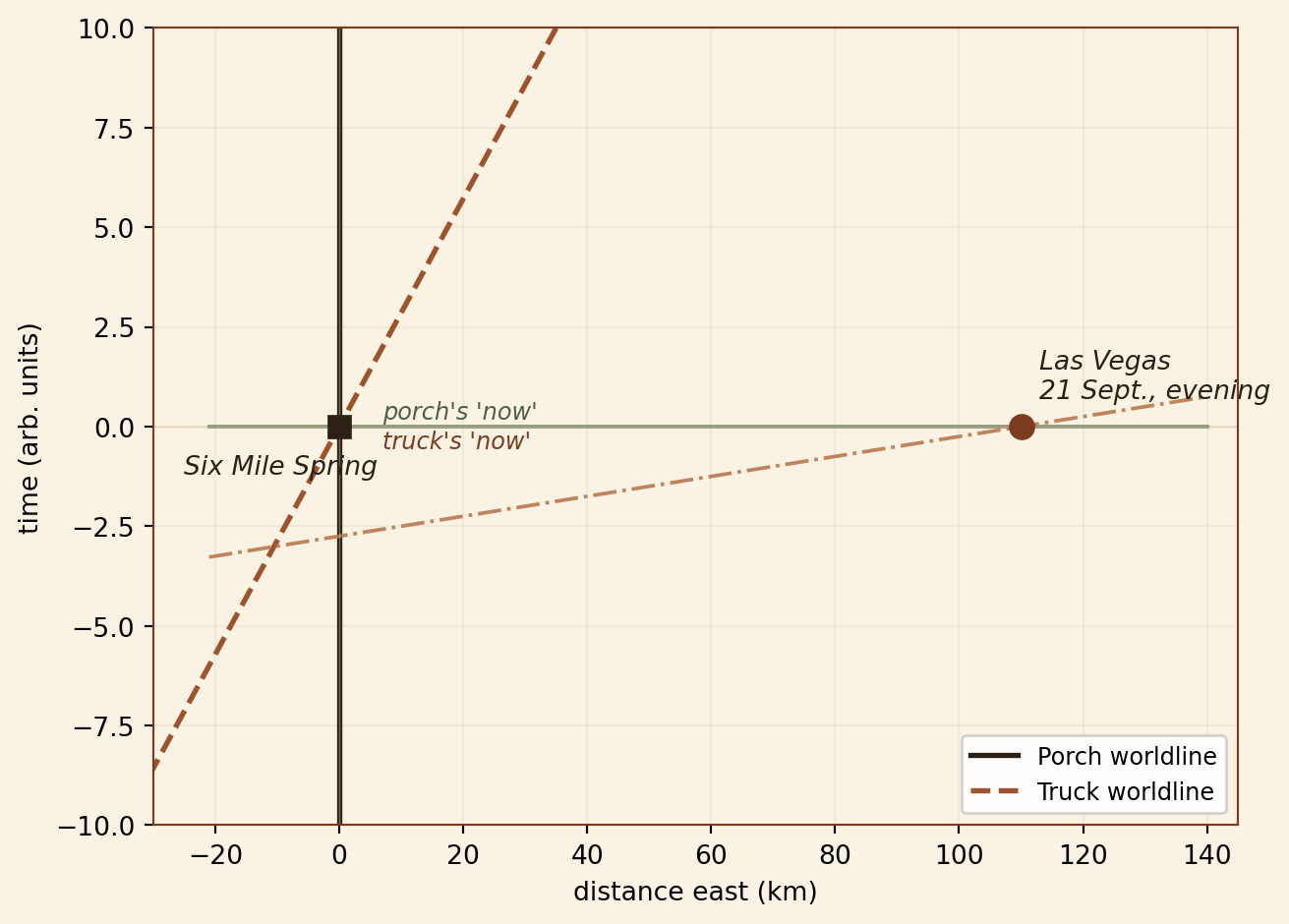
The diagram below renders the situation at Six Mile Spring. The vertical axis is time, the horizontal axis is the distance toward Las Vegas. The solid black line is the porch’s worldline; the slanted dashed line is the worldline of the eastbound truck. The two grey lines are the respective hyperplanes of simultaneity through the event labelled Vegas, evening of 21 September. The relative tilt — exaggerated by a factor of \(\sim 10^{6}\) for visibility — is the geometrical content of the disagreement.
import numpy as npimport matplotlib.pyplot as pltfig, ax = plt.subplots()# Spatial extent (km), time extent (arbitrary units)x_max =140t_max =10# Worldlines# Porch: vertical at x = 0ax.plot([0, 0], [-t_max, t_max], color="#2b2118", lw=2, label="Porch worldline")# Truck: tilted (exaggerated tilt for visibility)truck_v =0.35# exaggeratedax.plot([-t_max*truck_v*10, t_max*truck_v*10], [-t_max, t_max], color="#a0522d", lw=2, ls="--", label="Truck worldline")# Las Vegas eventvegas_x, vegas_t =110, 0ax.plot(vegas_x, vegas_t, "o", color="#7a3b1f", markersize=9, zorder=5)ax.annotate("Las Vegas\n21 Sept., evening", xy=(vegas_x, vegas_t), xytext=(vegas_x+3, vegas_t+0.7), fontsize=10, fontstyle="italic", color="#2b2118")# Hyperplane of simultaneity for the porch (horizontal through Vegas event)ax.plot([-x_max*0.15, x_max], [vegas_t, vegas_t], color="#7a8b6f", lw=1.4, alpha=0.9)ax.text(x_max*0.05, vegas_t+0.18, "porch's 'now'", fontsize=9, color="#4f5e48", fontstyle="italic")# Hyperplane of simultaneity for the truck: tilted by ~v in our exaggerated unitsplane_slope =0.025# exaggeratedxs = np.array([-x_max*0.15, x_max])ax.plot(xs, vegas_t + plane_slope*(xs - vegas_x), color="#b8794f", lw=1.4, alpha=0.9, ls="-.")ax.text(x_max*0.05, vegas_t -0.55, "truck's 'now'", fontsize=9, color="#7a3b1f", fontstyle="italic")# Six Mile Spring markerax.plot(0, 0, "s", color="#2b2118", markersize=8, zorder=5)ax.annotate("Six Mile Spring", xy=(0, 0), xytext=(-25, -1.2), fontsize=10, fontstyle="italic", color="#2b2118")# Cosmeticsax.set_xlim(-30, x_max+5)ax.set_ylim(-t_max, t_max)ax.set_xlabel("distance east (km)")ax.set_ylabel("time (arb. units)")ax.axhline(0, color="#d9b382", lw=0.5, alpha=0.5)ax.axvline(0, color="#d9b382", lw=0.5, alpha=0.5)ax.grid(alpha=0.15)ax.legend(loc="lower right", framealpha=0.9, fontsize=9)ax.set_facecolor("#faf3e3")fig.patch.set_facecolor("#faf3e3")for spine in ax.spines.values(): spine.set_color("#7a3b1f")plt.tight_layout()plt.show()
Figure 1: Two hyperplanes of simultaneity passing through a single event in Las Vegas. The tilt of the truck’s plane has been exaggerated for legibility; in reality, thirty picoseconds is a very thin slice.
What follows, and what does not
It would be excessive to claim that Equation 2, by itself, decides the metaphysical question. The argument requires an additional premise — that reality is what is simultaneous with one’s present — and this premise has been variously qualified, denied, or replaced (see, among others, Stein (1968) and Savitt (2000)). The literature is patient and remains open.
What Equation 2does establish, conclusively, is that any view of time which insists on a single objective now sweeping forward through the universe must explain why two observers, identically constituted, in demonstrably symmetrical situations, disagree about its location. The block universe — the view that all events of spacetime are equally real, and that the apparent flow of time is a feature of a particular kind of embedded perceiver and not of the world — is, at the very least, the view that demands the fewest auxiliary assumptions.
It has been remarked at the Institute, on more than one occasion, that the desert encourages the block-universe view. The night sky shows us the past; the rocks beneath show us a deeper past; the wind that has scoured them is, in the relevant geometrical sense, no less there than the boulder it is presently rounding. We have lived here long enough not to find this troubling.
References
Putnam, Hilary. 1967. “Time and Physical Geometry.”The Journal of Philosophy 64 (8): 240–47.
Rietdijk, C. W. 1966. “A Rigorous Proof of Determinism Derived from the Special Theory of Relativity.”Philosophy of Science 33 (4): 341–44.
Savitt, Steven F. 2000. “There’s No Time Like the Present (in Minkowski Spacetime).”Philosophy of Science 67: S563–74.