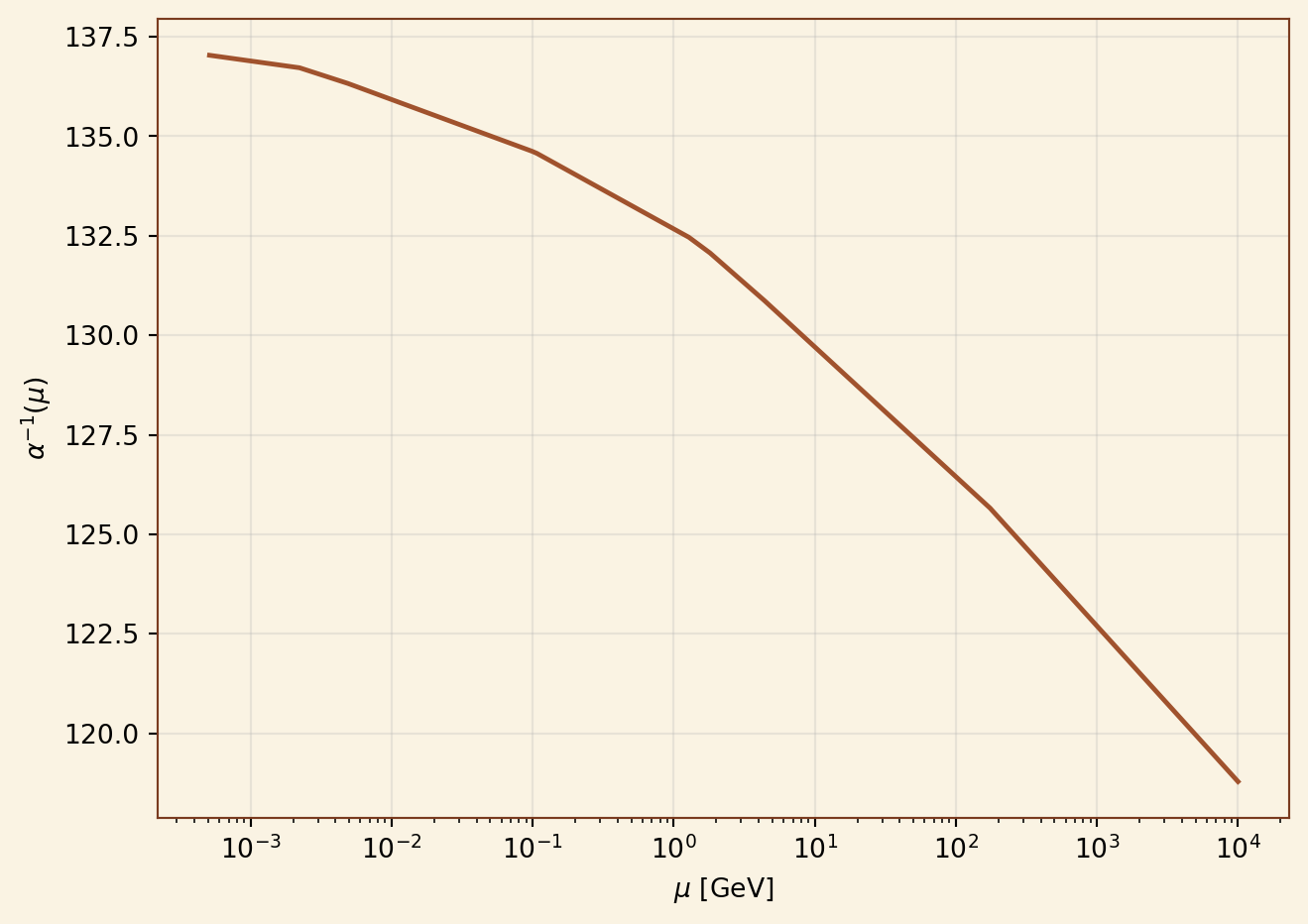
One-loop \(\beta\)-function, the Landau pole, and a plot of \(\alpha(\mu)\) from the electron mass to the TeV scale.
Author
Affiliation
M. Yucca
Chuck Walla Institute
Published
12 June 2014
Setting
The fine-structure constant is famously not constant. In QED, the renormalized coupling \(\alpha(\mu)\) depends on the energy scale \(\mu\) at which it is probed. At low energies one measures \(\alpha^{-1}(m_e) \approx 137.036\); at the \(Z\)-pole, \(\alpha^{-1}(M_Z) \approx 127.9\)(Peskin and Schroeder 1995).
This note records the one-loop derivation, plots \(\alpha(\mu)\) across fifteen decades, and remarks on the Landau pole.
The one-loop \(\beta\)-function
The QED \(\beta\)-function at one loop, in the on-shell scheme with a single charged fermion of charge \(Q_f\), is
where the step function counts only fermions lighter than the probe scale. Solving Equation 1 with the boundary condition \(\alpha(\mu_0) = \alpha_0\) gives
The denominator vanishes at the Landau pole\(\mu_{\text{LP}} = \mu_0 \exp\!\left[\frac{3\pi}{2\alpha_0 \sum Q_f^{2}}\right]\), located at an absurdly high energy and not believed to be physical.
New charged species speed up the running once \(\mu\) exceeds their masses, visible as kinks in Figure 1.
Numerical evaluation
We integrate Equation 2 across the Standard Model charged fermion spectrum.
import numpy as npimport matplotlib.pyplot as plt# Charged-fermion masses (GeV) and chargesfermions = [ ("e", 0.000511, -1), ("mu", 0.1057, -1), ("u", 0.0022, +2/3), ("d", 0.0047, -1/3), ("s", 0.095, -1/3), ("tau", 1.777, -1), ("c", 1.27, +2/3), ("b", 4.18, -1/3), ("t", 172.7, +2/3),]# Color factor for quarksdef Nc(name): return3if name in {"u","d","s","c","b","t"} else1alpha0_inv =137.036mu0 =0.000511# m_e in GeVmus = np.logspace(np.log10(mu0), np.log10(1e4), 4000)def alpha_inv(mu): s =0.0for name, m, Q in fermions:if mu > m: s += Nc(name) * Q**2* np.log(mu / m)return alpha0_inv - (2/(3*np.pi)) * svals = np.array([alpha_inv(m) for m in mus])fig, ax = plt.subplots()ax.plot(mus, vals, color="#a0522d", lw=1.8)ax.set_xscale("log")ax.set_xlabel(r"$\mu$[GeV]")ax.set_ylabel(r"$\alpha^{-1}(\mu)$")ax.grid(alpha=0.25)ax.set_facecolor("#faf3e3")fig.patch.set_facecolor("#faf3e3")for spine in ax.spines.values(): spine.set_color("#7a3b1f")plt.tight_layout()plt.show()
Figure 1: One-loop running of \(\alpha^{-1}(\mu)\) from \(m_e\) to \(10\,\text{TeV}\). Kinks at each charged-fermion threshold.
At \(\mu = M_Z \approx 91.19\,\text{GeV}\) the one-loop estimate gives
which lands within a percent of the precise value, the residual gap being absorbed by two-loop corrections and hadronic threshold effects.
A short table of milestones
Scale \(\mu\)
\(\alpha^{-1}(\mu)\) (one-loop)
\(m_e = 0.511\,\text{MeV}\)
\(137.04\)
\(m_\tau = 1.78\,\text{GeV}\)
\(\approx 133.5\)
\(M_Z = 91.2\,\text{GeV}\)
see above
\(10\,\text{TeV}\)
see plot
Remarks
The one-loop running already captures the essential phenomenon — the coupling strengthens as we probe shorter distances — and the formula Equation 2 is useful precisely because it is wrong in interesting ways. The triviality of QED is then not a defect of the calculation but a hint that QED, taken as a fundamental theory, must be embedded in a larger structure.
References
Peskin, Michael E., and Daniel V. Schroeder. 1995. An Introduction to Quantum Field Theory. Addison-Wesley.