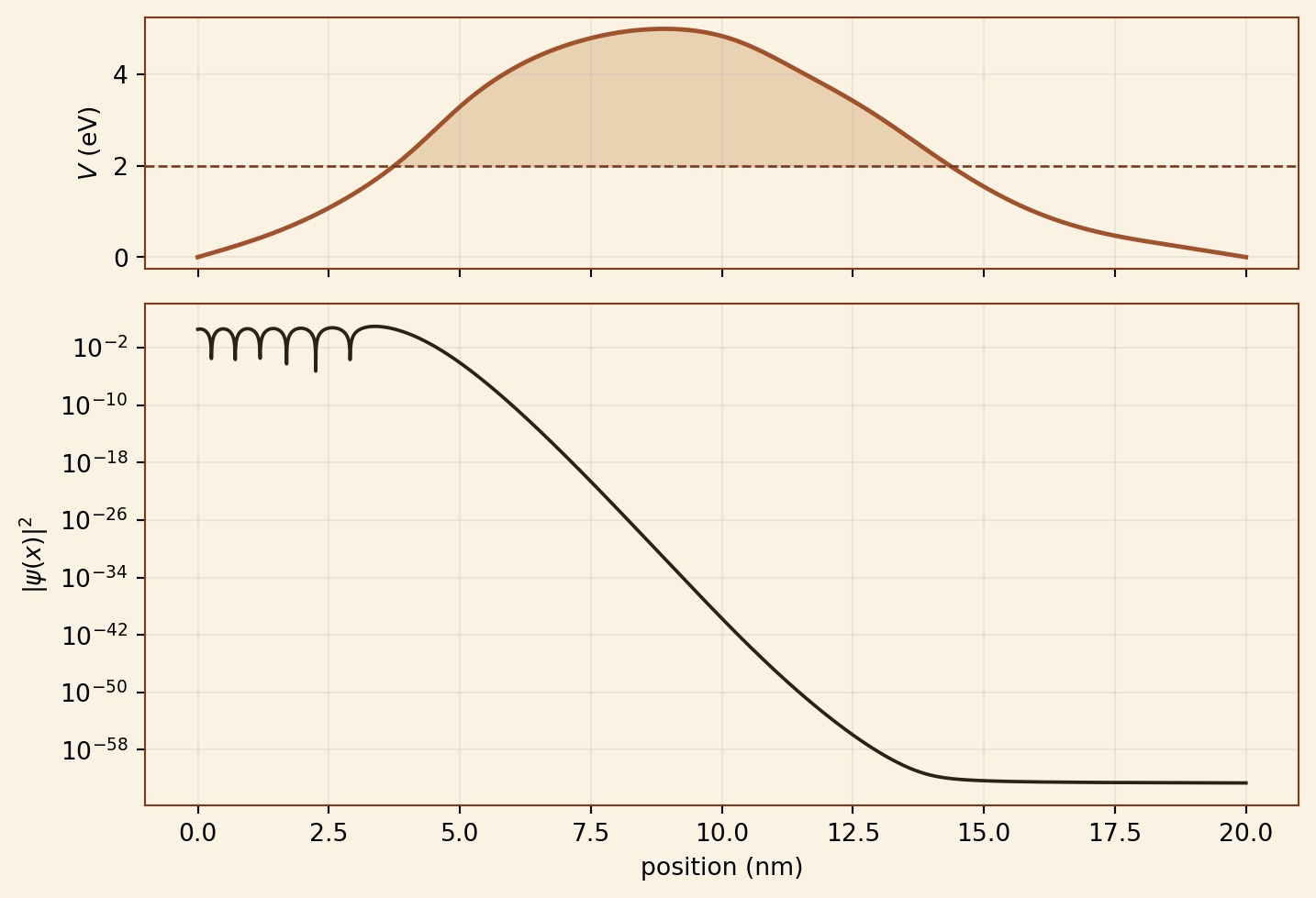
import numpy as np
import matplotlib.pyplot as plt
from scipy.interpolate import CubicSpline

hbar = 1.055e-34
me = 9.11e-31
eV = 1.602e-19

# Same surveyed profile as the original note
xs_m = np.array([0, 5, 10, 14, 18, 22, 26, 31, 36, 40, 45, 50, 55, 60, 65, 70])
hs_m = np.array([0, 1.4, 3.5, 6.0, 9.2, 11.5, 12.8, 13.4, 12.7, 11.0, 8.5, 5.5, 3.0, 1.5, 0.7, 0.0])

cs = CubicSpline(xs_m, hs_m, bc_type='natural')
N = 4000
x_grid = np.linspace(0, 70, N)
h_grid = np.maximum(cs(x_grid), 0)
V0_eV = 5.0
V_eV = V0_eV * (h_grid - h_grid.min()) / (h_grid.max() - h_grid.min())
V_J = V_eV * eV
E_eV = 2.0
E_J = E_eV * eV

# Real-space x in meters
L_real = 20e-9
x_real = x_grid * (L_real / 70.0)
dx = x_real[1] - x_real[0]

# Local wavevector (real or imaginary)
k = np.sqrt(2 * me * (E_J - V_J + 0j)) / hbar  # complex

# Build transfer matrices and propagate
def step_matrix(k1, k2, dx2):
    """Transfer (A,B) coefficients across one piecewise step of length dx2 with wavevector k2,
    matched into a region with wavevector k1 on the right."""
    p = k2 * dx2
    e_p = np.exp(1j*p); e_m = np.exp(-1j*p)
    return np.array([[e_p, 0], [0, e_m]])

# Cleaner: assemble using matching matrices at each interface
# This is a textbook scattering-matrix approach.
def transmission_and_psi(E_J, V_J, dx):
    k_arr = np.sqrt(2*me*(E_J - V_J + 0j))/hbar
    N = len(V_J)
    # On region N-1 (rightmost), only outgoing wave: A_R, B_R = (t, 0)
    # Propagate backward.
    t = 1.0 + 0j  # we'll normalize at end
    A = np.zeros(N, dtype=complex); B = np.zeros(N, dtype=complex)
    A[-1] = 1.0; B[-1] = 0.0
    for i in range(N-2, -1, -1):
        ki = k_arr[i]; kip = k_arr[i+1]
        # match psi and psi' at interface; assume the wave in region i is at x=0
        # and in region i+1 at x=dx (relative to region i)
        e_p = np.exp(1j * kip * dx)
        e_m = np.exp(-1j * kip * dx)
        A_ip = A[i+1] * e_p
        B_ip = B[i+1] * e_m
        # at interface: A_i + B_i = A_ip + B_ip
        #               ki(A_i - B_i) = kip(A_ip - B_ip)
        A[i] = 0.5 * ((A_ip + B_ip) + (kip/ki) * (A_ip - B_ip))
        B[i] = 0.5 * ((A_ip + B_ip) - (kip/ki) * (A_ip - B_ip))
    # Incident amplitude is A[0]; reflected is B[0]; transmitted is A[-1]
    incident = A[0]
    transmitted = A[-1]
    T = (k_arr[-1].real / k_arr[0].real) * abs(transmitted/incident)**2
    # Wavefunction on the grid: in each region take psi_i(x_local) = A_i + B_i (at left edge)
    # For visualization, reconstruct |psi|^2 on the grid
    psi = np.zeros(N, dtype=complex)
    for i in range(N):
        psi[i] = A[i] + B[i]
    psi /= incident  # normalize so incident amplitude is 1
    return T, psi, A/incident, B/incident

T_TM, psi, Aa, Bb = transmission_and_psi(E_J, V_J, dx)

fig, (ax1, ax2) = plt.subplots(2, 1, figsize=(7.6, 5.2),
                                gridspec_kw={'height_ratios':[1, 2]})

# Top: potential
ax1.plot(x_real*1e9, V_eV, color="#a0522d", lw=1.8)
ax1.axhline(E_eV, color="#7a3b1f", lw=1.0, ls="--")
ax1.fill_between(x_real*1e9, E_eV, V_eV, where=(V_eV > E_eV),
                 color="#d9b382", alpha=0.5)
ax1.set_ylabel(r"$V$ (eV)")
ax1.set_xticklabels([])
ax1.set_facecolor("#faf3e3")
ax1.grid(alpha=0.2)

# Bottom: |psi|^2 on log scale
ax2.semilogy(x_real*1e9, np.abs(psi)**2, color="#2b2118", lw=1.4)
ax2.set_xlabel("position (nm)")
ax2.set_ylabel(r"$|\psi(x)|^2$")
ax2.set_facecolor("#faf3e3")
ax2.grid(alpha=0.2, which="both")

for ax in (ax1, ax2):
    for spine in ax.spines.values():
        spine.set_color("#7a3b1f")

fig.patch.set_facecolor("#faf3e3")
plt.tight_layout()
plt.show()

# Compute WKB for comparison
forbidden = V_J > E_J
kappa = np.zeros_like(V_J)
kappa[forbidden] = np.sqrt(2*me*(V_J[forbidden] - E_J))/hbar
integral = np.trapezoid(kappa, x_real)
T_WKB = np.exp(-2*integral)

print(f"T_WKB           = {T_WKB:.3e}")
print(f"T_TransferMatrix = {T_TM:.3e}")
print(f"ratio T_TM / T_WKB = {T_TM/T_WKB:.3f}")