The Wheeler–DeWitt Equation and the Disappearance of \(t\)
quantum gravity
foundations
problem of time
On a fundamental equation that contains no time, on the Page–Wootters proposal that time emerges from correlation, and on what one keeps clocks for.
Author
Affiliation
D. R. Caldera
Chuck Walla Institute
Published
30 September 1986
A small admission
It has been remarked at the Institute, by the visitor who first noticed it, that since 1981 we have kept two clocks. One is the brass railroad clock that hangs in the seminar room; the other is a plain electric clock, mounted in the kitchen, which keeps better time. The remark is fairer than it sounds. The two clocks do not, strictly speaking, agree — the brass one runs slow by perhaps a minute a week, the electric one gains a few seconds a month — and the question of which is correct has been politely deferred for the better part of five years. The present note is, in some loose sense, the answer.
The relevant physics begins, as it often does, with an embarrassment. The canonical quantization of general relativity, set out by DeWitt (1967) and Wheeler (1968) and pursued in various forms by their successors, produces a wave functional \(\Psi[g_{ij}]\) on the space of three-geometries, satisfying the constraint
\[
\hat{H}\,\Psi[g_{ij}] \;=\; 0.
\tag{1}\]
The equation is called the Wheeler–DeWitt equation. It is presumably the equation governing the quantum state of the universe, and it has the disconcerting property of containing no time variable.
What is missing, and why
In ordinary quantum mechanics the Schrödinger equation has the form
and the parameter \(t\) is, however unscrutinized, there. It is the parameter against which the state evolves. The wavefunction at \(t = 0\) is something; the wavefunction at \(t = 1\,\text{s}\) is something related; the relation is provided by Equation 2, which presupposes that there is a \(t\) to differentiate with respect to.
In Equation 1 there is no such parameter. This is not a notational omission. The reasoning that produces Equation 1 — diffeomorphism invariance of the underlying gravitational theory — requires that no preferred time function appear. The universe, at its most fundamental level, does not evolve. It simply is, in some configuration that satisfies the constraint.
This is the problem of time, as canvassed at length by Kuchař (1991) and Isham (1992). The literature is large and the resolutions are many; none has won general assent.
The Page–Wootters proposal
The proposal due to Page and Wootters (1983), called by them evolution without evolution, is the one that has lodged most firmly in my own thinking. Their argument may be put as follows.
Consider a closed quantum system — a universe — composed of two subsystems, which we shall call \(A\) and \(B\). Suppose the joint state \(|\Psi\rangle_{AB}\) satisfies the timeless constraint
There is, by hypothesis, no external time. Now suppose that the state is correlated in the following sense: the subsystem \(B\) is what we shall call a clock, meaning that its Hamiltonian has a self-adjoint canonical conjugate \(\hat T_B\) — a position-like operator with a continuous spectrum. Then the conditional state of \(A\), given that the clock \(B\) has been observed to read the value \(t\), is
\[
|\psi_A(t)\rangle \;\equiv\; \frac{\langle t |_B\, |\Psi\rangle_{AB}}
{\bigl\| \langle t |_B\, |\Psi\rangle_{AB} \bigr\|}.
\tag{4}\]
A short calculation, using Equation 3, shows that this conditional state satisfies
That is: the timeless state, conditioned on the clock’s reading, looks to subsystem \(A\) exactly like the standard time-evolved quantum state of Equation 2. The parameter \(t\) which appeared to be missing has reappeared, not as a fundamental variable, but as the value of one subsystem’s reading correlated with the state of another.
A picture of two clocks
import numpy as npimport matplotlib.pyplot as pltfig, axes = plt.subplots(1, 3, figsize=(7.6, 2.8))# A series of three "snapshots" — each conditioned on a different reading of clock Bts = [0.0, 1.2, 2.4]for ax, t inzip(axes, ts):# Clock A: hand at angle proportional to t theta_A =-np.pi/2+1.3* t ax.add_patch(plt.Circle((0, 0), 1.0, fill=False, color="#7a3b1f", lw=1.6)) ax.plot([0, 0.7*np.cos(theta_A)], [0, 0.7*np.sin(theta_A)], color="#a0522d", lw=2.2)# Clock B's reading shown below as a dial reading ax.text(0, -1.6, f"clock $B$ reads $t = {t:.1f}$", ha="center", fontsize=10, color="#2b2118", fontstyle="italic") ax.text(0, 1.25, "clock $A$", ha="center", fontsize=10, color="#7a3b1f", fontstyle="italic")# Hour ticksfor k inrange(12): a =2*np.pi * k /12 ax.plot([0.92*np.cos(a), 1.0*np.cos(a)], [0.92*np.sin(a), 1.0*np.sin(a)], color="#7a3b1f", lw=0.9) ax.set_xlim(-1.4, 1.4) ax.set_ylim(-2.0, 1.5) ax.set_aspect("equal") ax.axis("off") ax.set_facecolor("#faf3e3")fig.patch.set_facecolor("#faf3e3")fig.suptitle(r"$|\psi_A(t)\rangle \ = \ \langle t|_B\,|\Psi\rangle_{AB}$", fontsize=11, color="#2b2118", y=0.04)plt.tight_layout()plt.show()
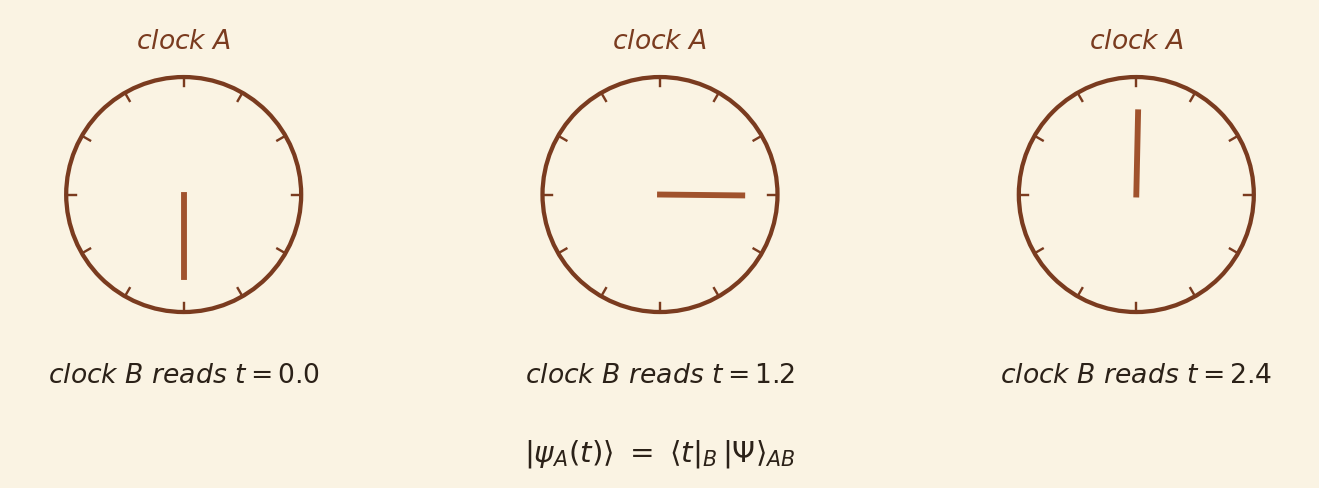
Figure 1: Two clocks, in a closed universe with no external time. The joint state is stationary; the apparent dynamics of clock A — its hand sweeping from one position to the next — is what an internal observer reports when she conditions on the reading of clock B. Time is what one of these clocks records about the other.
The figure shows what the proposal asks one to imagine. There is no animation in the underlying state — \(|\Psi\rangle_{AB}\) is, by Equation 3, an eigenstate of zero energy and does not change. The appearance of a moving hand on clock \(A\) is recovered when we look at the conditional state given each successive reading of clock \(B\). What looks like time is a property of the correlation between the two subsystems.
It is, I think, a quietly remarkable proposal. It does not solve the problem of time in the sense that any cosmologist would call solved; the construction is technically delicate, the decomposition of the universe into “clock” and “rest” is not unique, and the recovery of the standard semiclassical limit involves choices that the literature has not finished arguing over. But it does suggest that the disappearance of \(t\) from the fundamental equation is not a defect of the theory. Time is a relation, not a substance; the equation omits it as one might omit, from a description of a marriage, the exterior weather.
What the two clocks at the Institute have been doing
The brass clock in the seminar room and the electric clock in the kitchen do not, of course, satisfy a Wheeler–DeWitt constraint. Their correlations are mediated by a Hamiltonian that contains, among other things, the local power grid and the temperature of the brass case. But the structure of the situation is not different from the cosmological case in any deep way. Each clock measures the other. What we call time, when we glance at one and then at the other and say “the brass one is slow,” is a fact about how their readings are correlated. It is not a fact about a separately existing parameter which both are imperfectly tracking.
I have, since 1981, found this thought consoling. The clocks need not agree to keep good time. They need only keep correlated time. The difference matters principally to the physicist; for the rest of the Institute, breakfast occurs when the kitchen clock says it does, and the seminar begins, more or less, when the brass clock chimes.
A closing observation
The chuckwalla, Sauromalus ater, does not keep time. He notices the sun, and the temperature of the rocks, and the relative positions of the morning shadows; from these he assembles a record adequate to his needs. We are, in the relevant sense, doing the same. We have more clocks, and the corrections are more careful, and we sometimes write papers about the corrections; but the underlying activity is the old one, of inferring the state of one part of the world from the reading of another.
The brass clock has just struck, and although it is slow by perhaps a minute, the kitchen agrees that it is time to put the kettle on.
References
DeWitt, Bryce S. 1967. “Quantum Theory of Gravity. I. The Canonical Theory.”Phys. Rev. 160: 1113–48.
Isham, Christopher J. 1992. “Canonical Quantum Gravity and the Problem of Time.” In Integrable Systems, Quantum Groups, and Quantum Field Theories. Kluwer.
Kuchař, Karel V. 1991. “Time and Interpretations of Quantum Gravity.” In Proceedings of the 4th Canadian Conference on General Relativity and Relativistic Astrophysics. World Scientific.
Page, Don N., and William K. Wootters. 1983. “Evolution Without Evolution: Dynamics Described by Stationary Observables.”Phys. Rev. D 27: 2885–92.
Wheeler, John A. 1968. “Superspace and the Nature of Quantum Geometrodynamics.” In Battelle Rencontres, edited by C. M. DeWitt and J. A. Wheeler. Benjamin.