On the cone of light that precedes the desert dawn, on the dust that scatters it, and on what one is in fact looking at.
Author
Affiliation
E. Mesquite
Corresponding member, Chuck Walla Institute
Published
8 March 1992
A pyramid before sunrise
There is a particular hour in late winter, about ninety minutes before sunrise, when the eastern sky over the Spring Mountains contains a pale luminous cone, broad at the horizon, narrowing to a point some forty degrees above. The cone is not centered on the place where the sun will rise. It is centered on the ecliptic, which on a March morning meets the horizon at an angle of nearly seventy degrees, and the cone follows that line. It is brighter than the Milky Way. From a sufficiently dark site — and the dirt section of Last Chance Road, two miles south of the Institute, is sufficiently dark — it is, on a clear moonless morning, quite hard to overlook.
The phenomenon is the zodiacal light. It is, in plain terms, sunlight scattered by the cloud of interplanetary dust which lies in the plane of the solar system. The dust is mostly cometary, with a contribution from the slow grinding of asteroids; the grains are tens of microns in size, and there are several billion tonnes of them distributed across a region extending well past the orbit of Mars (Leinert et al. 1998). The total mass is small — comparable to that of a single mid-sized asteroid — but spread over so vast a volume that the column density along the ecliptic is sufficient to produce a visible glow.
What the eye is doing
The eye, at this hour, is performing a long and difficult act of integration. It is collecting photons from the sun — most of them from a region between perhaps \(0.1\) and \(5\) astronomical units — that have been redirected by single scattering off the surfaces of dust grains and that arrive at the dark-adapted observer at intensities between perhaps \(30\) and \(300\,S_{10}\) units, where one \(S_{10}\) is the surface brightness of one tenth-magnitude star per square degree. The total integrated brightness of the zodiacal light, summed over the sky, is comparable to that of all the unresolved stars in the Milky Way put together (Reach 1996).
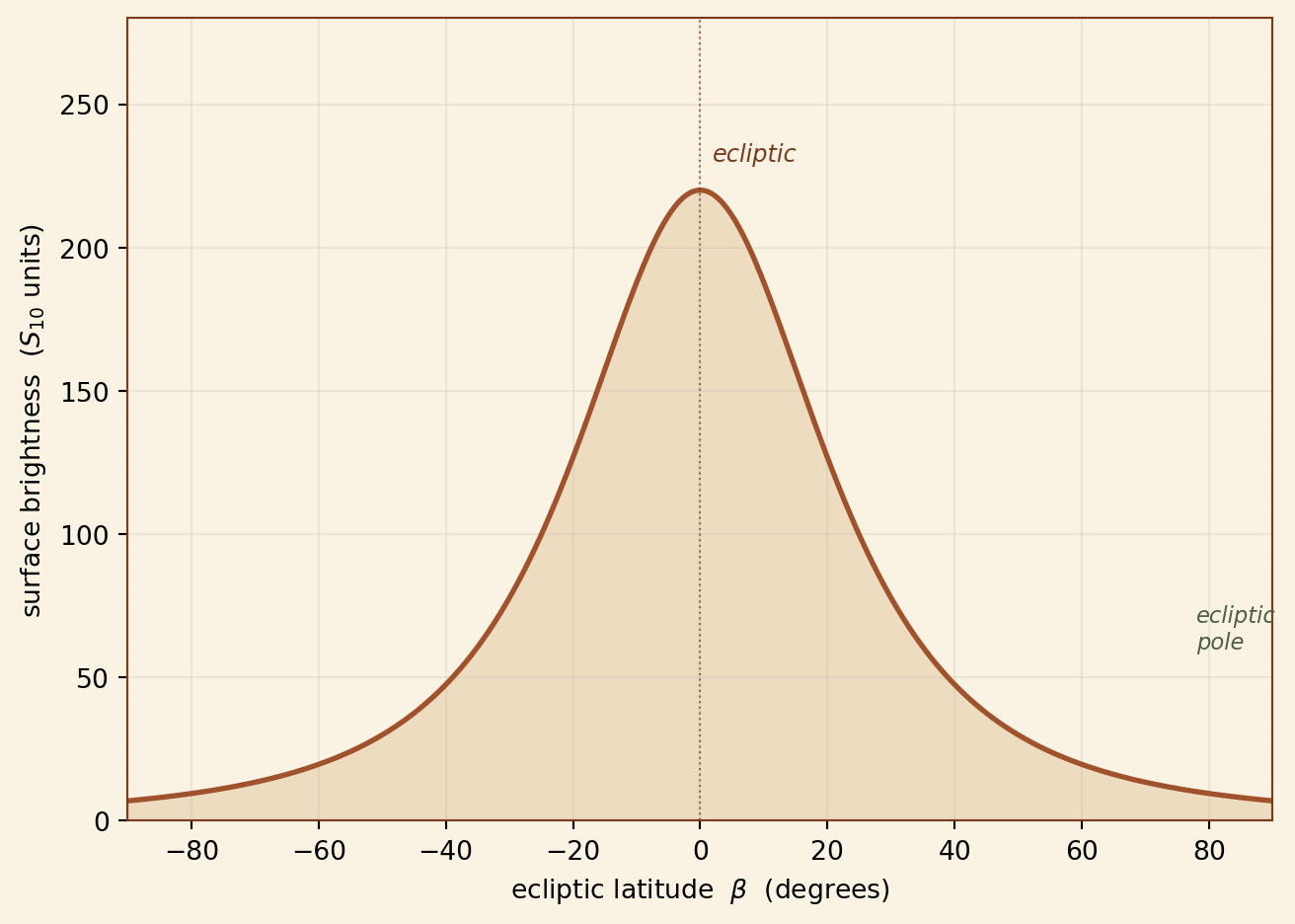
The intensity, as a function of ecliptic latitude \(\beta\) and elongation \(\epsilon\) from the sun, is well-fit at small ecliptic latitudes by an empirical relation of the form
with \(\beta_{0} \approx 30^{\circ}\), applicable in the range \(\epsilon \gtrsim 30^{\circ}\) where the inner-zodiacal physics is not the dominant contribution (Leinert et al. 1998). The form Equation 1 encodes two facts: that the dust is concentrated near the ecliptic plane, and that the column density falls off with distance from the sun roughly as \(1/r\).
import numpy as npimport matplotlib.pyplot as pltbeta = np.linspace(-90, 90, 600)beta0 =30.0I = (1+ (beta/beta0)**2)**(-1.5)I_full =220* I # in S_10 units, schematic normalization at eclipticfig, ax = plt.subplots()ax.plot(beta, I_full, color="#a0522d", lw=2.0)ax.fill_between(beta, 0, I_full, color="#d9b382", alpha=0.35)# Ecliptic and pole markersax.axvline(0, color="#7a3b1f", lw=0.8, ls=":", alpha=0.7)ax.text(2, 230, "ecliptic", color="#7a3b1f", fontsize=9, fontstyle="italic")ax.axvline(90, color="#7a8b6f", lw=0.8, ls=":", alpha=0.6)ax.axvline(-90, color="#7a8b6f", lw=0.8, ls=":", alpha=0.6)ax.text(78, 60, "ecliptic\npole", color="#4f5e48", fontsize=8.5, fontstyle="italic")ax.set_xlabel(r"ecliptic latitude $\beta$(degrees)")ax.set_ylabel(r"surface brightness ($S_{10}$ units)")ax.set_xlim(-90, 90)ax.set_ylim(0, 280)ax.grid(alpha=0.2)ax.set_facecolor("#faf3e3")fig.patch.set_facecolor("#faf3e3")for spine in ax.spines.values(): spine.set_color("#7a3b1f")plt.tight_layout()plt.show()
Figure 1: Surface brightness of the zodiacal light as a function of ecliptic latitude, at fixed solar elongation \(\epsilon = 90^{\circ}\). The cone observed near the horizon is the integral of this profile along the line of sight, taken near the antisolar point of the morning sky.
The slow falloff with \(\beta\) is what gives the cone its considerable breadth at the horizon. Were the dust confined to a thin disk, the zodiacal light would be a narrow ribbon; instead, it is a pyramid.
The morning in question
The morning these notes record was the eighth of March, 1992. The moon had set at half past one. The sky was clear in the way that desert skies are clear after a windy day, with the dust settled and the air dry. I drove south on Last Chance Road, parked where the washboard becomes uncomfortable, and waited on the hood with a thermos and an old Brunton compass.
The cone came up at about a quarter past five. It was visible to the naked eye for perhaps forty minutes before astronomical twilight began to wash it out. Below the cone, just at the horizon, I caught once or twice the brighter inner gegenschein — the diffuse backscattering from dust at the antisolar point, an entirely separate phenomenon and the harder one to see — though the geometry was wrong for a clean detection.
A pair of bats, as is usual at that hour, came past low and turned inland.
What is being measured
The zodiacal light is not, in cosmological terms, important. The extragalactic background, which I have written about elsewhere (Mesquite 1988), is fainter by orders of magnitude. The scientific interest of the zodiacal light is principally that it is a foreground: to measure the diffuse extragalactic background light from any satellite mission whose orbit crosses the ecliptic plane — which is most of them — one must subtract the zodiacal contribution to better than a percent. The DIRBE instrument aboard COBE did this work patiently between 1989 and 1990 (Hauser et al. 1998), and the careful zodiacal model (Kelsall et al. 1998) that resulted is, in some quiet sense, the price one pays for having seen anything at all of the sky beyond.
But the cone, observed from the desert, is not a foreground to anyone in particular. It is what a few billion tonnes of cometary debris look like in the right light. The grains, individually, are smaller than one can see; the cloud, integrated, is the second-brightest diffuse object in the inner solar system. We who live where the air is dark are the people who get to see it.
A small closing note
A naked eye can register the zodiacal light from perhaps three hundred sites in the lower forty-eight states. Last Chance Road is one of them. I would urge the visitor — particularly the visitor arriving in autumn, when the morning ecliptic stands steepest — to rise an hour earlier than is comfortable, walk south of the Institute, and look east. The pyramid is patient. It will wait for the eye to adapt.
References
Hauser, M. G. et al. 1998. “The COBE Diffuse Infrared Background Experiment Search for the Cosmic Infrared Background.”The Astrophysical Journal 508: 25–43.
Kelsall, T. et al. 1998. “The COBE Diffuse Infrared Background Experiment Search for the Cosmic Infrared Background. II. Model of the Interplanetary Dust Cloud.”The Astrophysical Journal 508: 44–73.
Leinert, C. et al. 1998. “The 1997 Reference of Diffuse Night Sky Brightness.”Astron. Astrophys. Suppl. Ser. 127: 1–99.
Mesquite, E. 1988. “Olbers’ Paradox at Three a.m. At Six Mile Spring.”Notes & Preprints, Chuck Walla Institute.
Reach, William T. 1996. “Zodiacal Emission. I. Dust Near the Earth’s Orbit.”The Astrophysical Journal 471: 888–97.